


How Dubai is becoming the World's #1 Tech Destination: Taxes, Talent, and Trillion-Dollar Opportunities
Updated: Aug 2, 2025
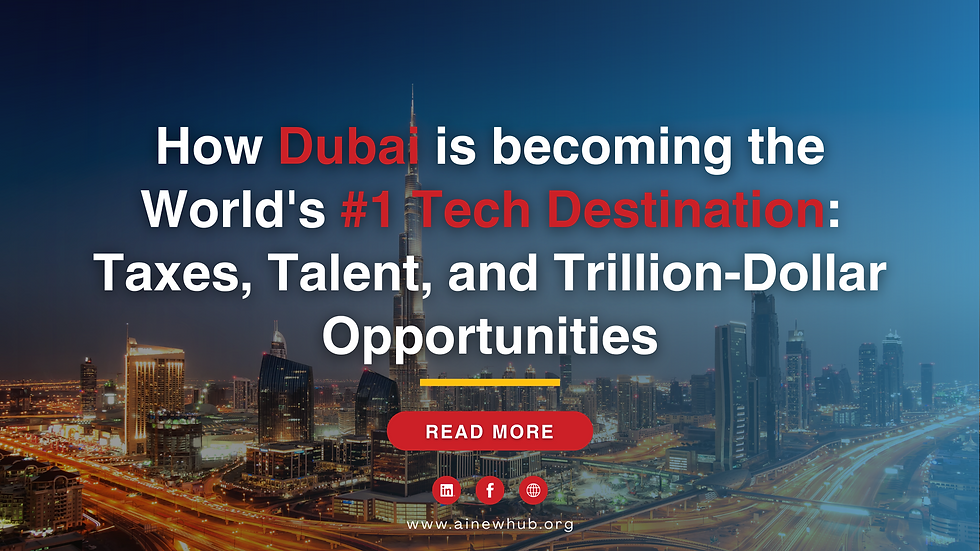
Not long ago, the global technology map was dominated by a few key cities. Today, a new powerhouse has transformed its futuristic skyline into a symbol of technological ambition, engineering its rise from a regional trading post to one of the world's most dynamic tech ecosystems. That city is Dubai.
This ascent was no accident. It's a masterclass in strategic vision, government-led innovation, and the creation of an irresistible ecosystem for talent and capital. But how did Dubai cement its status, and what does its future hold, particularly in the age of AI? This guide breaks down the key pillars of its unstoppable rise.
Dubai's Tech Ambition By the Numbers:

AI & Web3 Hub: The DIFC AI & Web3 Campus aims to house over 500 AI and Web3 firms and create 3,000 jobs by 2028.
Metaverse Leadership: The city's Metaverse Strategy targets the creation of 40,000 virtual-economy jobs and a $4 billion contribution to GDP by 2030.
Green Tech Future: A 140,000 m² Urban Tech District is under construction, set to create 4,000 jobsin green and sustainable technology.
The Blueprint: A Vision for a Post-Oil Future

The bedrock of Dubai's tech revolution is its forward-thinking government. Recognizing the finite nature of oil wealth decades ago, the UAE's leadership laid out a bold vision for a diversified, knowledge-based economy, backed by decisive action.
Pro-Business Free Zones: The establishment of numerous free zones like Dubai Internet City (DIC), Dubai Silicon Oasis (DSO), and the Dubai International Financial Centre (DIFC) was a game-changer. These zones offer foreign companies 100% ownership, 0% personal income tax, and full repatriation of profits, creating a low-friction, high-incentive environment that global firms couldn't ignore.
Attracting Global Talent: To attract and retain the world's best minds, the UAE introduced the Golden Visa, a long-term residency program for investors, entrepreneurs, and specialized professionals in fields like science, technology, and artificial intelligence. This provided stability and sent a clear message: Dubai is where you can build your future.
Digital-First Governance: Through initiatives like Smart Dubai and the Dubai 10X agenda, the government has aggressively pursued a digital-first strategy, aiming to become the world's first paperless government and position its public services 10 years ahead of other cities. This top-down embrace of digitalization has created a city-wide culture of innovation.
The Catalyst: GITEX GLOBAL's Four-Decade Reign
No discussion of Dubai's tech scene is complete without mentioning GITEX GLOBAL. First launched in 1981 as a modest IT trade show, GITEX has exploded into the world's largest and most influential technology event, attracting over 200,000 attendees from 180+ countries annually.
For over four decades, GITEX has been the crucial bridge bringing the titans of Silicon Valley and the innovations of the East to the Middle East. It's where global product launches happen, billion-dollar deals are signed, and national digital strategies are unveiled. The evolution of GITEX—from a simple IT show to a sprawling campus of events covering everything from AI and blockchain to fintech and cybersecurity—mirrors Dubai's own technological journey. It's the annual heartbeat of the region's tech ecosystem.
The Gravity Well: Why the Titans of Tech Call Dubai Home
The success of Dubai's strategy is evident in the names that now call the city their regional home. The world's most influential technology companies have established major operations in Dubai to serve the rapidly growing MEASA (Middle East, Africa, and South Asia) region. This dense concentration of tech giants creates a powerful gravity, pulling in smaller companies, startups, and a massive pool of skilled talent.
Company | Dubai Presence & Key Milestones |
Microsoft | Regional HQ and first cloud data centers in the UAE, powering Azure and AI services. Expanding its AI and engineering R&D across the nation. |
Regional HQ and Innovation Hub in DIC, hosting MENA Cloud and Ads teams and frequent AI developer hackathons. | |
Amazon (AWS) | Established its Middle East (UAE) Region with three Availability Zones, providing cloud infrastructure for thousands of regional businesses. |
NVIDIA | A strong and growing presence, working with public and private sectors to build sovereign AI capabilities and power the region's AI revolution. |
Meta | Regional headquarters capitalizing on the city's position as a digital communication and content creation hub for the Middle East. |
Oracle | Regional HQ and a dedicated cloud region (OCI) in Dubai, serving enterprise clients across the Middle East and Africa. |
ByteDance (TikTok) | A major corporate services hub hiring across engineering, operations, and content. The Creator Lounge fuels the MENA content boom. |
Talent Pipeline & Deep-Tech Academia
Dubai isn’t merely importing expertise—it’s manufacturing it locally. Flagship institutions like the Mohamed bin Zayed University of Artificial Intelligence (MBZUAI) and Dubai’s Khalifa University satellite are churning out world-class researchers in machine learning, robotics, and quantum computing. Add branch campuses of NYU, RIT, and Heriot-Watt, and you have a steady stream of PhDs, data scientists, and product designers who’d otherwise head straight to Silicon Valley. The result is a self-reinforcing loop where startups can hire elite talent without leaving the city, while students see a clear pathway from classroom to venture-backed career.

The 24/7 Advantage: Time Zones That Never Sleep
Dubai's GMT+4 time zone creates a unique operational advantage that tech companies are increasingly leveraging. With a 4-hour overlap with European markets in the morning and Asian markets in the evening, Dubai-based teams can maintain continuous development cycles and customer support. This "follow-the-sun" model has proven particularly valuable for AI companies running global data processing operations and SaaS platforms serving international clients. Major consulting firms report that Dubai-based operations can accelerate project timelines by 20-30% compared to single-timezone alternatives, making it a secret weapon for companies competing on speed-to-market.
Building Tomorrow: Dubai's Audacious Future Projects

Dubai isn't resting on its laurels. The government has launched a series of groundbreaking initiatives designed to secure its position as a leader in next-generation technology.
The Dubai AI and Metaverse Strategies: These twin initiatives are central to Dubai's future. The city has a dedicated Minister for Artificial Intelligence and a clear goal to integrate AI into every aspect of government services. The metaverse strategy complements this by fostering a new digital economy built on Web3 and immersive technologies.
The DIFC Innovation Hub & AI Campus: Located within the city's financial center, this new campus offers subsidized licenses, world-class infrastructure, and access to capital, creating a powerful cluster for AI and fintech startups to collaborate with global financial institutions.
The Museum of the Future: This architectural marvel is more than a landmark; it's an incubator and accelerator for futuristic ideas. It symbolizes the city's unwavering commitment to innovation and serves as a hub for research into AI-driven solutions and emerging technologies.
The Dubai Autonomous Transportation Strategy: This ambitious plan aims to make 25% of all transportation in Dubai autonomous by 2030, involving partnerships with leading companies to develop self-driving cars, delivery drones, and smart transit infrastructure.
The Infrastructure That Just Works

Behind Dubai's tech success lies infrastructure investment that rivals any global city. The emirate's data centers offer 99.999% uptime guarantees, supported by redundant power grids and advanced cooling systems optimized for the desert climate. Dubai's Internet Exchange (DIXE) routes 40% of regional internet traffic, ensuring low-latency connections across three continents. The city's 5G network achieves speeds of up to 1.2 Gbps in commercial areas, with plans for 6G trials beginning in 2026. For tech companies, this means deploying applications without infrastructure concerns—a stark contrast to emerging markets where connectivity remains a bottleneck. The government's $1 billion investment in quantum computing infrastructure, scheduled for completion by 2027, positions Dubai as a future hub for next-generation computing applications.
The Startup Revolution: From Venture Capital to Unicorns
While tech titans provide the anchor, the dynamism of Dubai's ecosystem comes from its explosive startup scene. The availability of venture capital has increased dramatically, with numerous international and local funds establishing operations to invest billions of dollars into homegrown ideas. This has created a vibrant ecosystem where innovation can access the capital needed for rapid growth.
This financial fuel is matched by robust infrastructure. Government-backed programs like the Dubai Startup Hub provide comprehensive support through funding, mentorship, and market access initiatives. Specialized incubators and accelerators within the free zones, such as in5 in DIC, nurture entrepreneurs at every stage of their journey, from ideation to international expansion.
The results speak for themselves. Dubai has produced numerous success stories, with several startups achieving unicorn status (a valuation over $1 billion) and expanding globally. These high-profile exits and achievements create a powerful feedback loop, validating the ecosystem's strength and attracting a new wave of ambitious founders and investors to the city.
Regulatory “Test-Bed” Advantage
Few places in the world let you pilot drones, driverless shuttles, crypto exchanges, and telemedicine platforms under one roof—but Dubai’s sector-specific sandboxes do exactly that. Agencies like VARA (Virtual Assets Regulatory Authority) and the Dubai Future District Fund provide clear guidelines, expedited licensing, and even government procurement guarantees for successful pilots. For founders, that means faster time-to-market and immediate access to paying customers—often the city itself.
Beyond the Buzzwords: Deep Dives into Key Tech Sectors

Dubai’s tech growth isn't limited to a single area; it's a multi-faceted expansion across several key verticals, each becoming a powerhouse in its own right.
FinTech and Web3: Leveraging the regulatory sandbox and global prestige of the DIFC, Dubai has become one of the world's most progressive hubs for financial technology. Its early adoption of comprehensive regulations for cryptocurrency and blockchain provided the legal clarity needed to attract countless digital banking, payments, and Web3 companies.
E-commerce and Logistics: Capitalizing on its strategic location and world-class port and airport infrastructure, Dubai is the undisputed e-commerce hub for the region. The explosive growth in digital adoption, coupled with a high-disposable income population, has made it a critical base of operations for major online retailers and digital marketing agencies serving the Middle East and beyond.
Cybersecurity: As digital transformation accelerates, the need for robust security has become paramount. Dubai has invested heavily in becoming a regional leader in cybersecurity, attracting top-tier firms and developing local expertise to protect the critical digital infrastructure that underpins its smart city ambitions.
The Human Element: An Unmatched Lifestyle for Global Talent

A key ingredient in Dubai's success is its undeniable appeal as a place to live. Tech companies can build offices anywhere, but talent will only move to places they want to call home. Dubai excels in this regard:
Safety and Stability: Consistently ranked as one of the safest cities in the world.
Tax-Free Income: A major draw for high-earning tech professionals looking to maximize their potential.
World-Class Infrastructure: From its hyper-modern metro system to its world-leading airport, the city is designed for efficiency and comfort.
A Global Crossroads: With over 200 nationalities living and working together, it is a true melting pot of cultures, offering a diverse and cosmopolitan lifestyle that fosters creative collaboration.
Frequently Asked Questions (FAQ)
Is Dubai a good place for a career in technology?
Absolutely. Dubai is a rapidly growing tech hub with a high demand for skilled professionals in AI, cybersecurity, fintech, and software development. The tax-free income, high safety standards, and presence of major global companies make it a very attractive destination for a tech career.
Why are so many big tech companies moving to Dubai?
Tech giants like Microsoft, Google, and NVIDIA have established regional headquarters in Dubai due to its strategic location serving the Middle East, Africa, and South Asia (MEASA), its pro-business policies (100% foreign ownership, 0% tax), world-class infrastructure, and access to a growing pool of global talent.
What is the Dubai Metaverse Strategy?
The Dubai Metaverse Strategy is a government initiative aiming to make Dubai a top 10 metaverse economy globally. The plan seeks to attract over 1,000 blockchain and metaverse companies, create 40,000 virtual jobs, and add $4 billion to the city's GDP by 2030.
What is the role of GITEX GLOBAL in Dubai's tech scene?
GITEX GLOBAL is the annual centerpiece of Dubai's tech ecosystem. For over 40 years, it has been the region's largest and most influential tech event, acting as a catalyst for business deals, a launchpad for startups, and a platform where global tech leaders and policymakers convene to shape the future of technology.
The Final Word: The Future is Forged in Dubai
Dubai's journey from a regional trading hub to a global technology powerhouse has been extraordinary. By combining visionary leadership, strategic investment, and a relentless focus on creating an attractive environment for both businesses and people, the city has firmly established itself as a critical node in the global technology network.
For startups seeking capital, scale-ups looking for a regional headquarters, or AI professionals chasing the next big challenge, Dubai offers an unmatched stack of policy, infrastructure, and lifestyle perks. As the world moves deeper into the age of artificial intelligence, all eyes are on Dubai to see what future it builds next. 🚀


Comments