


Space-Based Data Centres: The Future of AI Computing in 2025

In an era where artificial intelligence (AI) is reshaping industries, the demand for massive computing power has skyrocketed. Data centers on Earth are struggling to keep up, consuming vast amounts of energy and facing environmental scrutiny. Enter space-based AI computing and orbital data centers: a futuristic solution that's rapidly becoming reality.
As of 2025, tech giants and startups are exploring how to launch AI infrastructure into orbit, harnessing unlimited solar energy to power the next generation of AI models. This comprehensive guide delves into the concept of space AI computing, its benefits, challenges, key projects, market projections, and future prospects, highlighting why orbital computing could be the key to sustainable AI growth.
With AI trends in 2025 emphasizing scalability and efficiency, Space-Based Data Centres offer a paradigm shift. Keywords like "space AI computing," "orbital data centers," and "space-based AI infrastructure" are buzzing in tech circles, driven by innovations from companies like Google and Starcloud. Let's explore how this technology could transform the AI landscape.
What Are Space-Based Data Centres?

Space-based AI computing refers to deploying data centers or computing clusters in orbit, typically in low Earth orbit (LEO), to handle AI workloads such as model training, inference, and data processing. Unlike traditional terrestrial data centers, these orbital setups leverage satellites equipped with high-performance processors, like NVIDIA GPUs or Google's TPUs, connected via optical inter-satellite links for distributed computing.
The idea isn't entirely new. Early concepts date back to discussions on off-planet storage, but the AI boom has accelerated development. In 2025, projects focus on solar-powered satellites that operate in sun-synchronous orbits, ensuring constant exposure to sunlight for uninterrupted power. For instance, these systems could process Earth observation data in real-time, aiding applications like wildfire detection or climate monitoring.
A conceptual rendering of a space-based data center, like Starcloud's proposed orbital setup, shows massive solar panels spanning kilometers, integrated with compute modules and advanced cooling systems. This design addresses Earth's limitations by utilizing the vacuum of space for natural heat dissipation, though it requires innovative engineering for radiation protection and reliability.
Key Components of Orbital Data Centers
Compute Hardware: Radiation-hardened GPUs and TPUs capable of withstanding cosmic rays and extreme temperature fluctuations. These specialized processors undergo rigorous testing to ensure operational integrity in space environments.
Power Systems: Photovoltaic arrays providing gigawatt-scale energy without grid constraints. Solar panels in space can generate continuous power without weather interference or nighttime interruptions, achieving energy density far beyond terrestrial installations.
Communication Infrastructure: High-bandwidth laser links for data transfer between satellites and ground stations. These optical communication systems can transmit terabytes of data with minimal latency, enabling real-time coordination between orbital and ground-based systems.
Cooling Mechanisms: Radiative cooling or liquid immersion systems to manage heat in microgravity. The vacuum of space provides unique advantages for thermal management, though it also presents engineering challenges that require novel solutions.
As AI infrastructure demand surges, projected to double global data center power needs by 2030, space offers virtually unlimited expansion potential. Experts predict that by 2027, prototypes could demonstrate viable orbital AI training, paving the way for commercial adoption.
Market Size and Growth Projections
The space-based data center market is positioned for explosive growth over the next decade. While still in its nascency, industry analysts project significant expansion as technology matures and costs decline.
Current Market Landscape

As of 2025, the space-based AI computing market is valued at approximately $500 million, primarily driven by research initiatives and prototype deployments. This represents a small fraction of the global data center market, which exceeds $200 billion annually. However, the trajectory suggests rapid acceleration.
Growth Forecasts
2025-2030 Projections: Market analysts forecast the orbital data center sector to reach $15-20 billion by 2030, representing a compound annual growth rate (CAGR) of 85-90%. This growth is driven by decreasing launch costs, technological maturation, and increasing energy constraints on Earth.
2030-2035 Outlook: By 2035, space-based AI infrastructure could capture 10-15% of new data center investments, translating to a market size exceeding $75 billion. This assumes successful demonstration of commercial viability and continued reduction in launch costs.
Investment Drivers
Several factors are accelerating investment in orbital computing:
Energy Crisis: Terrestrial data centers are projected to consume 8-10% of global electricity by 2030, creating unsustainable demand on power grids.
AI Model Scaling: Next-generation AI models require 100x more computing power than current systems, pushing beyond Earth's capacity.
Launch Cost Reduction: SpaceX's Starship and other reusable systems are driving launch costs toward $10-20 per kilogram, making orbital infrastructure economically viable.
Regulatory Pressure: Increasing environmental regulations on data center emissions are making space-based alternatives more attractive.
Space vs. Traditional Data Centers: A Comprehensive Comparison

Understanding the advantages and trade-offs of orbital computing requires a detailed comparison with terrestrial infrastructure.
Energy Efficiency and Costs
Traditional Data Centers:
Energy efficiency: 20-40% (power usage effectiveness or PUE of 1.5-2.5)
Energy cost: $0.05-0.15 per kWh
Carbon footprint: 2-3% of global emissions
Peak capacity limitations based on grid availability
Space-Based Data Centers:
Energy efficiency: 90-95% (solar panels receive unfiltered sunlight 24/7)
Projected energy cost: $0.005-0.01 per kWh at scale
Carbon footprint: Minimal operational emissions (launch carbon offset within 2-3 years)
Unlimited scaling potential
Capital Expenditure Analysis
Terrestrial Data Centers: Initial investment of $10-15 million per megawatt, including land acquisition, construction, cooling infrastructure, and power systems. Operational costs remain constant throughout the facility's 15-20 year lifespan.
Orbital Data Centers: Higher initial investment of $50-100 million per megawatt, primarily due to launch costs and specialized hardware. However, operational costs are projected to be 70-80% lower due to free solar energy and reduced maintenance needs. Break-even analysis suggests cost parity within 5-7 years of operation.
Performance Metrics
Latency: Traditional data centers offer 1-10ms latency for local connections. Orbital systems face 20-50ms latency for ground communications but enable near-zero latency for satellite-to-satellite processing.
Reliability: Terrestrial facilities achieve 99.99% uptime (52 minutes downtime annually). Space systems target 99.9% uptime initially, with redundancy protocols to minimize service disruption.
Scalability: Ground infrastructure faces physical constraints from land availability, permitting, and community opposition. Orbital systems can expand virtually without limit, adding capacity through modular satellite deployments.
Environmental Impact
Traditional data centers consume massive amounts of water for cooling (2-5 million gallons per megawatt annually) and contribute significantly to local heat islands. Space-based systems eliminate water consumption entirely and export heat pollution beyond Earth's atmosphere, though launch emissions require consideration.
A lifecycle analysis suggests that orbital data centers become carbon-neutral within 3-5 years of operation, compared to ongoing emissions from terrestrial facilities. This makes space-based computing increasingly attractive as environmental regulations tighten globally.
Benefits of Moving AI Computing to Space

The allure of space-based data centers lies in their potential to solve Earth's most pressing AI challenges: energy scarcity, environmental impact, and scalability. Here's a comprehensive breakdown of the key advantages:
1. Unlimited Renewable Energy
In orbit, solar panels receive constant, unfiltered sunlight, achieving up to 10 times the efficiency of ground-based systems. This could slash energy costs by 95%, making AI training economically viable at scale. For example, Starcloud projects 10x lower costs than terrestrial options, even factoring in launch expenses.
No more reliance on fossil fuels or strained power grids. Space AI computing could run on clean, abundant solar power 24/7, without weather interruptions or nighttime gaps. A single orbital data center with 1 square kilometer of solar panels could generate 1.4 gigawatts continuously, equivalent to a large nuclear power plant but with zero emissions.
2. Environmental Sustainability
Terrestrial data centers contribute to carbon emissions and water usage for cooling. Orbital systems eliminate these issues by offloading compute to space, reducing Earth's ecological footprint. Proponents argue this could help meet global climate goals, especially as AI's electricity demand is expected to rise 165% by 2030.
Additionally, space-based processing for satellite data minimizes latency for Earth-bound applications, enhancing efficiency in sectors like agriculture and disaster response. By removing heat generation from Earth's surface, orbital computing also reduces urban heat island effects that plague major data center hubs.
3. Scalability and Flexibility
Space offers infinite "real estate" without land permits or community opposition. Gigawatt-scale constellations could support massive AI models, far beyond what's feasible on Earth. Distributed computing via inter-satellite links enables seamless scaling, ideal for high-density AI workloads.
The modular nature of satellite deployments allows for rapid capacity expansion. Companies can launch additional compute modules as demand grows, without the 18-24 month construction timelines typical of terrestrial facilities. This agility is crucial for meeting the exponential growth in AI computing needs.
4. Enhanced Security and Data Sovereignty
Orbital data centers could provide isolated environments, reducing risks from cyberattacks or geopolitical tensions. Physical access is essentially impossible, creating an inherent security advantage over ground facilities. For sensitive government or financial AI workloads, this isolation offers unprecedented protection.
For remote areas, orbital systems ensure connectivity during natural disasters, fostering global AI accessibility. Countries without robust terrestrial infrastructure can access world-class computing resources through satellite links, democratizing AI capabilities globally.
5. Innovation in Edge Computing
Real-time AI inference in space could revolutionize fields like autonomous satellites or space exploration. Imagine AI analyzing Mars rover data on-site, without Earth round-trips that introduce 8-20 minute delays. Orbital processing enables real-time decision-making for deep space missions, asteroid mining operations, and satellite constellation management.
For Earth observation applications, processing data in orbit before transmission reduces bandwidth requirements by 90-95%, as only relevant insights need to be sent to ground stations rather than raw satellite imagery.
6. Reduced Geopolitical Risk
Data sovereignty concerns are increasing as nations impose restrictions on where data can be stored and processed. Orbital data centers operating in international space provide neutral territory, reducing regulatory complexities for multinational AI operations. This is particularly valuable for global AI models that aggregate data from multiple jurisdictions.
Overall, these benefits position space AI computing as a high-demand solution for 2025's AI trends, potentially driving massive adoption across industries seeking sustainable, scalable computing infrastructure.
Real-World Applications and Use Cases
Space-based AI computing isn't just theoretical; it enables specific applications that are impossible or impractical with terrestrial infrastructure.

Earth Observation and Climate Monitoring
Orbital AI can process satellite imagery in real-time, detecting wildfires within seconds of ignition rather than the current 30-60 minute delay. Climate scientists can run complex atmospheric models using space-based computing, analyzing terabytes of sensor data without transmitting it to Earth first.
Applications include:
Real-time deforestation tracking with hourly updates
Ocean temperature analysis for hurricane prediction
Agricultural monitoring for crop health and yield optimization
Arctic ice sheet monitoring for climate change research
Autonomous Satellite Operations
AI models running in space enable satellite constellations to coordinate autonomously, optimizing coverage patterns, collision avoidance, and communication routing without ground control delays. This is critical for mega-constellations like Starlink, which will eventually comprise 40,000+ satellites requiring real-time traffic management.
Deep Space Exploration
Future Mars missions could leverage orbital AI infrastructure around Earth for mission planning and simulation before spacecraft departure. Once established around other planets, these systems would enable autonomous rover operations, habitat management, and resource extraction with immediate AI decision-making.
Scientific Research and Simulation
Complex simulations in astrophysics, materials science, and molecular biology benefit from orbital computing's massive parallel processing capabilities. Research institutions can run months-long simulations at a fraction of terrestrial costs, accelerating scientific discovery.
Defense and National Security
Military applications include real-time intelligence analysis, autonomous threat detection, and secure communications processing. Several nations are investing in military-specific orbital computing capabilities, recognizing the strategic advantage of space-based AI infrastructure.
Financial Modeling and High-Frequency Trading
While latency considerations limit some financial applications, complex risk modeling and portfolio optimization benefit from orbital computing's cost efficiency. Financial institutions could run thousands of Monte Carlo simulations continuously at a fraction of current costs.
Challenges in Deploying Orbital AI Data Centers

Despite the promise, space-based AI infrastructure faces significant hurdles that could delay widespread adoption. Addressing these is crucial for turning concepts into reality.
1. High Launch and Operational Costs
Rocket launches remain expensive, though companies like SpaceX are reducing prices with reusable vehicles like Starship. Building a 5-gigawatt orbital data center might require 50-100 launches, with initial estimates putting costs at $5-10 billion for full deployment.
Current launch costs average $1,500-3,000 per kilogram to LEO. For a 100-ton orbital data center module, this translates to $150-300 million per module. However, SpaceX's Starship targets $10-20 per kilogram, which would reduce module launch costs to $1-2 million, making orbital infrastructure economically competitive.
The break-even analysis depends heavily on achieving scale. Initial deployments will be expensive, but costs decline rapidly as launch frequency increases and hardware becomes standardized.
2. Technical Hurdles: Radiation and Thermal Management
Cosmic radiation can corrupt data and damage hardware, necessitating shielded designs. Google's Project Suncatcher is testing TPUs in space to validate resilience against radiation-induced errors. Current estimates suggest radiation hardening adds 30-50% to hardware costs and reduces performance by 20-30% compared to terrestrial equivalents.
Cooling presents another challenge. While space's vacuum aids radiative cooling, microgravity complicates liquid systems. Engineers are exploring phase-change materials and radiative panels that can dissipate heat effectively in orbital environments. Solar flares and space weather add risks of disruptions, requiring redundant systems and automatic shutdown protocols during extreme events.
Advanced error correction algorithms and redundant computing architectures can mitigate radiation effects, but these add complexity and cost. The trade-off between radiation protection, performance, and reliability remains a key engineering challenge.
3. Communication Latency and Bandwidth
Data transfer between orbit and Earth involves inherent delays. Even at the speed of light, LEO communications introduce 20-50ms latency. For latency-sensitive applications like real-time video processing or high-frequency trading, this is problematic.
However, laser communication links are advancing rapidly. NASA's recent demonstrations achieved 1.2 Gbps data rates from lunar distance, suggesting that bandwidth limitations can be overcome. For distributed AI training where latency is less critical, satellite-to-satellite communication at near-zero latency enables massive parallel processing.
Hybrid architectures that combine orbital computing for training heavy
models and ground-based systems for low-latency inference represent a practical solution. This approach leverages the strengths of both environments while minimizing their respective weaknesses.
4. Regulatory and Environmental Concerns
International space law is evolving, with debates on orbital debris and spectrum allocation. The Outer Space Treaty of 1967 establishes basic principles, but modern mega-constellations require updated regulatory frameworks. Critics warn that large constellations could exacerbate space junk, potentially causing collisions that create debris cascades.
Current projections suggest that adding thousands of data center satellites could increase collision risk by 15-20% without proper traffic management systems. International coordination through bodies like the United Nations Committee on the Peaceful Uses of Outer Space (COPUOS) is essential but moves slowly.
Environmental concerns extend beyond debris. The carbon footprint of launches might offset some green benefits initially, though lifecycle analysis suggests orbital data centers become carbon-neutral within 3-5 years. Atmospheric pollution from rocket launches, particularly if launch frequency increases dramatically, requires monitoring and mitigation strategies.
Spectrum allocation for communication links is another regulatory challenge. Orbital data centers require significant bandwidth for data transfer, competing with existing satellite services, GPS systems, and telecommunications infrastructure.
5. Maintenance and Reliability
Repairing satellites is challenging and expensive. Hardware must last 5-7 years before replacement or refurbishment missions become economically viable. This demands robust, autonomous systems with AI for self-diagnosis and adaptive operation.
Current satellite lifespans average 10-15 years, but data center hardware typically requires replacement every 3-5 years to maintain performance competitiveness. This creates a fundamental tension between the economics of space deployment and the rapid evolution of computing technology.
Modular designs that allow component replacement without deorbiting entire satellites may offer a solution. Robotic servicing missions, currently being demonstrated by companies like Northrop Grumman, could extend satellite lifespans and enable hardware upgrades in orbit.
6. Power Distribution and Energy Storage
While solar energy is abundant in space, power distribution across large computing clusters presents engineering challenges. Orbital data centers must manage energy storage for eclipse periods when satellites pass through Earth's shadow, even though these periods are relatively brief in sun-synchronous orbits.
High-efficiency battery systems or alternative energy storage methods are required to maintain operations during eclipses and for peak load management. Current lithium-ion technology adds significant mass, impacting launch costs and orbital mechanics.
Experts from industry discussions question whether Earth's advancing renewable energy infrastructure might ultimately prove more practical than orbital solutions. As terrestrial solar and wind capacity grows and battery technology improves, the relative advantage of space-based computing may diminish. Yet, with AI driving demand for ultra-high-density computing that exceeds grid capacity in key regions, overcoming these challenges could unlock unprecedented growth in both AI capabilities and space industry development.
Leading Projects and Companies in Space AI Computing
Several pioneers are pushing the boundaries of orbital data centers, each approaching the challenge from different angles:

Google's Project Suncatcher
Launched in November 2025, this moonshot initiative aims to deploy TPU-equipped satellites by 2027, testing distributed machine learning in space. Partnering with Planet Labs for satellite expertise, Project Suncatcher explores gigawatt-scale constellations for scalable AI processing.
The project focuses on validating three key hypotheses: radiation resilience of TPU chips, thermal management in vacuum conditions, and cost-effectiveness of orbital training compared to terrestrial alternatives. Initial deployments involve 10-15 satellites in a distributed mesh network, coordinating via laser communication links.
Google's long-term vision includes a 1,000-satellite constellation providing 10 gigawatts of AI computing capacity by 2032, sufficient to train the next generation of large language models entirely in orbit. The company is investing $2-3 billion in the initial phase, demonstrating serious commitment to orbital infrastructure.
Starcloud
This NVIDIA-backed startup plans a November 2025 satellite launch featuring H100 GPUs adapted for space environments. CEO Philip Johnston predicts most new data centers will be space-based within a decade, targeting 5-gigawatt orbital data centers by 2028.
Starcloud's business model focuses on selling computing capacity to AI companies and research institutions, effectively becoming a "cloud provider in orbit." Early customers include academic institutions conducting climate research and startups training large vision models for satellite imagery analysis.
The company has raised $450 million in Series A funding from investors including NVIDIA, Sequoia Capital, and Lux Capital. Their roadmap includes quarterly satellite launches through 2027, gradually building capacity and refining operational procedures.
SpaceX and Starlink Integration
While not officially announced, Elon Musk's SpaceX is widely believed to be exploring orbital computing capabilities that leverage Starship for cost-effective launches and Starlink for connectivity infrastructure. Internal documents suggest SpaceX is evaluating AI compute modules that could be integrated into future Starlink satellites.
The synergy is obvious: Starlink's 5,000+ satellite constellation provides a ready-made network infrastructure, and Starship's 100-ton payload capacity enables deploying massive compute modules. If SpaceX enters the orbital data center market, their vertical integration and launch cost advantages could be game-changing.
Industry observers note that SpaceX has been hiring AI infrastructure specialists and data center architects, suggesting active development. An official announcement could come in 2026, potentially accelerating the entire industry's timeline.
Blue Origin and Jeff Bezos' Vision
Jeff Bezos has long advocated for moving heavy industry, including energy-intensive computing, off Earth. While Blue Origin hasn't announced specific data center projects, the company's New Glenn rocket and planned orbital manufacturing capabilities position it well for the space computing market.
Bezos' speeches frequently reference a future where Earth is "zoned residential and light industrial," with heavy computing and manufacturing conducted in space. Blue Origin's partnerships with defense contractors suggest potential government-sponsored orbital computing initiatives may be in development.
European ASCEND Initiative
The European Space Agency's ASCEND (Advanced Space Cloud for European Net zero emissions and Data sovereignty) program studies CO2 reduction via orbital computing setups. Funded with 300 million euros through 2027, ASCEND focuses on European energy independence and data sovereignty through space-based infrastructure.
The initiative emphasizes sustainability metrics and regulatory frameworks that could shape international standards. ASCEND plans a demonstration mission in 2026, deploying a small-scale orbital data center module to validate European technologies and operational concepts.
China's Orbital Supercomputer Program
China has launched experimental AI satellites as part of an orbital supercomputer initiative, reflecting the strategic importance nations place on space-based computing. The program, operated by the China National Space Administration (CNSA), deployed three test satellites in 2024 equipped with domestic AI accelerators.
Chinese state media indicates plans for a 50-satellite constellation by 2028, focusing on Earth observation, autonomous systems, and AI model training. The program receives substantial government funding as part of China's broader space ambitions and AI development strategy.
Academic and Research Initiatives
Universities including MIT, Stanford, and the European Space Agency are conducting foundational research on space-based computing architectures. These efforts focus on radiation-hardened algorithms, distributed learning protocols, and economic modeling to inform commercial development.
NASA's Small Business Innovation Research (SBIR) program has funded multiple startups exploring orbital computing concepts, providing grants totaling $75 million since 2023. This public funding is accelerating technology development and de-risking early-stage ventures.
These efforts, highlighted in industry forums and technical conferences, underscore the high interest in space AI computing across public and private sectors. The diversity of approaches suggests multiple viable pathways to commercial orbital data centers.
Investment Landscape and Funding Trends
The financial ecosystem around space-based AI computing is rapidly maturing, attracting significant capital from diverse sources.
Venture Capital Activity
Space-focused venture funds have invested over $1.2 billion in orbital computing startups since 2023. Notable investors include:
Space Capital: Leading multiple rounds, particularly focused on enabling technologies like radiation-hardened processors and laser communication systems
Lux Capital: Major backer of Starcloud and other space infrastructure companies
Founders Fund: Peter Thiel's fund has allocated significant capital to space computing, viewing it as a civilization-level technology shift
NVIDIA's Venture Arm: Strategic investments in companies using their GPUs for space applications
Deal sizes are growing rapidly, with Series A rounds now exceeding $100 million for companies with demonstrated technology, compared to $10-20 million rounds typical in 2022.
Corporate Strategic Investments
Tech giants are making strategic bets beyond Google's direct involvement:
Microsoft: Exploring Azure space computing services, investing in ground station infrastructure
Amazon: AWS Space Accelerator program supporting startups, potential future orbital infrastructure
Meta: Research into orbital AI for global connectivity and processing
Apple: Undisclosed initiatives related to satellite communication and potential computing integration
These investments suggest that major cloud providers view orbital computing as a future competitive battleground rather than a niche market.
Government Funding and Contracts
Defense and space agencies globally are providing significant funding:
U.S. Space Force: $500 million allocated for orbital computing research through 2027
NASA: Commercial partnerships and technology development contracts totaling $200 million
European Space Agency: ASCEND program and related initiatives funded at 300 million euros
DARPA: Multiple programs exploring space-based AI for defense applications
Government contracts provide stable revenue for early-stage companies, reducing risk and enabling longer development timelines. Military applications may subsidize civilian technology development, similar to how GPS and the internet evolved.
Public Market Interest
While no pure-play orbital computing companies have gone public yet, several adjacent firms are seeing increased valuations:
Satellite manufacturers: Companies producing space-qualified hardware are experiencing valuation increases of 40-60% since 2023
Launch services: SpaceX's valuation exceeds $180 billion, partly driven by orbital infrastructure potential
Space SPAC activity: Multiple special purpose acquisition companies have been formed to target space computing mergers
Industry analysts predict the first orbital data center company IPO could occur in 2027-2028, potentially at multi-billion dollar valuations if technology demonstrations prove successful.
Geopolitical Implications and Strategic Considerations
Space-based AI computing carries significant geopolitical weight, as nations recognize control of orbital infrastructure as a strategic advantage comparable to historical contests over territory, resources, and maritime routes.
Strategic Competition
The United States and China are engaged in a space computing race reminiscent of the Cold War space race, but with economic rather than purely scientific objectives. Both nations view orbital AI infrastructure as critical for:
Military advantage: AI-enabled autonomous defense systems and intelligence analysis
Economic leadership: Whoever controls orbital computing may dominate AI development
Technological sovereignty: Reducing dependence on foreign computing infrastructure
Europe, through initiatives like ASCEND, seeks to maintain technological independence and prevent domination by U.S. or Chinese orbital platforms. India, Japan, and other space-capable nations are developing national strategies to ensure access to orbital computing resources.
Data Sovereignty and Privacy
Orbital data centers operating in international space create complex legal questions:
Jurisdiction: Which nation's laws apply to data processed in orbit?
Surveillance concerns: Can governments access data processed by orbital systems?
Export controls: Do restrictions on AI technology transfer apply to orbital systems?
International frameworks are struggling to keep pace with technology. The Outer Space Treaty designates space as the "province of all mankind" but provides limited guidance on data processing and digital services. New treaties or international agreements may be necessary.
Military Applications and Arms Control
Space-based AI computing has obvious military applications, raising concerns about weaponization and strategic stability:
Autonomous weapon systems: Orbital AI could enable fully autonomous military capabilities
Anti-satellite capabilities: Computing infrastructure becomes a potential target in conflict
Intelligence analysis: Real-time processing of reconnaissance satellite data provides tactical advantages
Arms control advocates warn that an orbital computing arms race could destabilize international security. Proposals for international agreements limiting military uses of space AI infrastructure have been discussed but face significant diplomatic challenges.
Resource Allocation and Space Traffic Management
As orbital data centers proliferate, competition for optimal orbits intensifies. Sun-synchronous orbits and other ideal trajectories are limited resources. International coordination through bodies like the International Telecommunication Union (ITU) and COPUOS is essential but slow-moving.
Spectrum allocation for communication links is another area of international negotiation, with potential for conflict if major powers unilaterally deploy systems without global coordination.
Economic Implications for Developing Nations
Space-based computing could democratize access to AI resources for developing nations without terrestrial data center infrastructure. However, it could also widen digital divides if access is controlled by wealthy nations or corporations.
International development organizations are exploring frameworks to ensure equitable access to orbital computing resources, potentially through UN-managed orbital infrastructure or mandated capacity-sharing agreements.
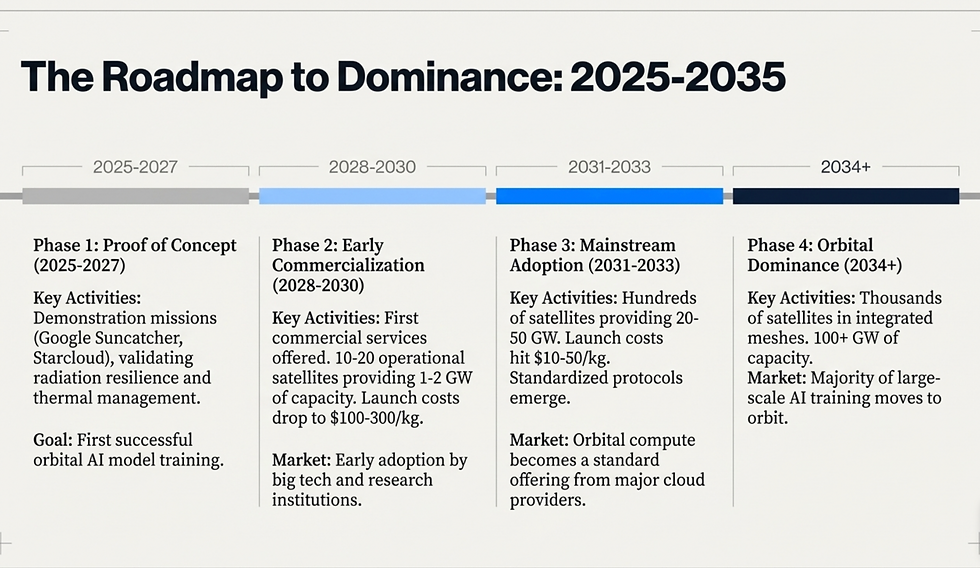
The Technology Roadmap: 2025-2035
Understanding the likely evolution of space-based AI computing helps contextualize current developments and future possibilities.
Phase 1: Proof of Concept (2025-2027)
Current Status: Multiple demonstration missions in progress, validating core technologies.
Key Milestones:
Google's Project Suncatcher demonstration (2027)
Starcloud's initial constellation deployment (2026-2027)
NASA radiation testing results for various processors
First successful orbital AI model training demonstration
Expected Outcomes: Validation that orbital computing is technically feasible, with initial cost and performance data informing commercial viability assessments.
Phase 2: Early Commercial Deployment (2028-2030)
Projected Developments:
First commercial orbital data center services offered to customers
Launch costs declining to $100-300 per kilogram as reusable rocket technology matures
10-20 operational orbital data center satellites providing 1-2 gigawatts of computing capacity
Hybrid Earth-orbit computing architectures becoming standard for large AI training runs
Market Dynamics: Early adopters primarily large tech companies and research institutions willing to pay premium prices for sustainable, scalable computing. Competition intensifies as multiple providers enter the market.
Phase 3: Mainstream Adoption (2031-2033)
Anticipated Progress:
Launch costs reaching $10-50 per kilogram, making orbital infrastructure cost-competitive with terrestrial alternatives
Hundreds of operational satellites providing 20-50 gigawatts of computing capacity
Established supply chains for space-qualified hardware at scale
Standardized protocols for orbital computing operations and data transfer
Industry Impact: Major cloud providers offering orbital computing as standard service option. Significant portion of new AI training workloads shifting to space-based infrastructure. Regulatory frameworks maturing with international cooperation.
Phase 4: Orbital Computing Dominance (2034-2035)
Long-Term Vision:
Thousands of satellites forming integrated orbital computing meshes
100+ gigawatts of space-based AI computing capacity
Majority of large-scale AI training conducted in orbit
Lunar surface data centers emerging for even greater energy availability and isolation
Earth data centers focusing on low-latency inference and edge computing
Transformative Effects: AI development accelerates dramatically due to abundant, low-cost computing. Environmental benefits become apparent as terrestrial data center growth plateaus. Space industry employs millions in supporting roles.
Alternative Scenarios
Optimistic Case: Breakthroughs in launch costs or computing efficiency accelerate timeline by 2-3 years. Orbital computing achieves dominance by 2032.
Pessimistic Case: Technical challenges or regulatory obstacles delay commercial viability. Terrestrial renewable energy advances reduce orbital advantages. Timeline extends to 2040 or beyond for mainstream adoption.
Most Likely: Gradual progression through phases as outlined, with orbital computing capturing 20-30% of new data center capacity by 2035, coexisting with terrestrial infrastructure in hybrid architectures.
Frequently Asked Questions (FAQ)
How much does it cost to launch a data center into space?
Current estimates for launching a 100-ton orbital data center module range from $150-300 million using existing rockets. With SpaceX's Starship and other next-generation launch vehicles, costs could decline to $1-2 million per module by 2027-2028. Total deployment costs for a commercial-scale facility (5 gigawatts) are estimated at $5-10 billion initially, but operational cost savings could enable break-even within 5-7 years.
How do space-based data centers handle cooling without air?
Space data centers use radiative cooling, emitting heat as infrared radiation into the vacuum of space. Large radiator panels, similar to those on the International Space Station, dissipate heat efficiently without requiring water or air circulation. Some designs incorporate phase-change materials or heat pipes to transport heat from computing components to radiators. The vacuum of space is actually advantageous for certain cooling approaches, though microgravity requires novel engineering solutions.
What happens to space data centers when satellites fail or become obsolete?
Satellites have planned operational lifespans of 5-7 years, after which they either deorbit naturally (for LEO) or are actively deorbited to prevent space debris. Modular designs allow component replacement via robotic servicing missions, potentially extending lifespans. Hardware obsolescence is managed through rolling upgrades, similar to terrestrial data centers but with longer replacement cycles due to launch costs. Companies factor replacement costs into total ownership calculations.
Can space-based AI data centers be hacked?
Security is actually enhanced in space compared to terrestrial facilities. Physical access is impossible, eliminating many attack vectors. Communication links use encrypted laser transmission, harder to intercept than terrestrial fiber or wireless. However, vulnerabilities exist in ground control systems and communication protocols. Defense-in-depth security architectures with redundant systems and autonomous operations reduce hacking risks. Many experts consider orbital data centers more secure than ground facilities for sensitive workloads.
How does latency affect space-based computing?
Communication between LEO satellites and Earth introduces 20-50ms latency, unsuitable for real-time applications like video streaming or high-frequency trading. However, for AI model training and batch processing, latency is largely irrelevant. Satellite-to-satellite communication at near-zero latency enables distributed training without delays. Hybrid architectures using space for training and ground for inference optimize performance. As AI workloads increasingly favor massive parallel training over real-time inference, latency concerns diminish.
Will space-based computing replace all terrestrial data centers?
No. The most likely scenario involves hybrid architectures where each environment handles workloads suited to its strengths. Space excels at energy-intensive AI training, large-scale simulations, and batch processing. Earth-based facilities will continue handling low-latency applications, edge computing, and services requiring immediate user interaction. By 2035, projections suggest 20-30% of new data center capacity being orbital, complementing rather than replacing terrestrial infrastructure.
How do space data centers deal with space debris?
Collision avoidance is critical. Satellites use propulsion systems and autonomous navigation to avoid tracked debris. Coordination with space traffic management systems ensures safe operations. Operators implement end-of-life deorbit plans to prevent creating additional debris. Shielding protects against micrometeorites. Industry standards are emerging for responsible space operations. The challenge intensifies as satellite density increases, requiring increasingly sophisticated traffic management and international coordination.
Who regulates space-based data centers?
Currently, regulation is fragmented. Launch activities fall under national space agencies (FAA in the U.S., ESA in Europe, etc.). Radio frequency use is coordinated through the International Telecommunication Union. Data privacy and sovereignty involve multiple national and international frameworks. The Outer Space Treaty provides basic principles, but lacks specific guidance for commercial data processing. New regulatory frameworks are being developed through international cooperation, but significant gaps remain. Expect ongoing regulatory evolution throughout the 2020s and 2030s.
The Future Outlook for Orbital AI Infrastructure
By 2030, space-based data centers could handle a significant portion of AI workloads, especially as launch costs drop below $100 per kilogram and technology matures through operational experience. Predictions include lunar servers for even greater isolation and abundant energy, with initial lunar surface data centers possibly operational by 2035.
Hybrid Earth-space models will likely dominate, optimizing for each environment's strengths. Terrestrial facilities handle latency-sensitive applications and edge computing, while orbital infrastructure powers large-scale AI training and energy-intensive simulations. This distributed architecture maximizes efficiency and sustainability across the computing ecosystem.
As AI trends evolve, orbital computing might enable breakthroughs previously constrained by energy and environmental limitations. Quantum AI, neuromorphic computing, and other advanced architectures could find ideal testing grounds in space environments. The unique conditions of orbit, microgravity, and unlimited solar energy may enable computing paradigms not feasible on Earth.
Integration with Broader Space Economy
Space-based AI computing is emerging as a cornerstone of the broader orbital economy. Integration with other space industries creates synergies:
Satellite servicing: Robotic maintenance and upgrade services enable longer operational lifespans
In-orbit manufacturing: Producing components in space reduces launch mass and costs
Space tourism: Wealthy individuals visiting orbital facilities for direct observation of AI research
Asteroid mining: AI processing orbital data to identify valuable near-Earth objects
These interconnections suggest space computing is part of a larger economic transformation, not an isolated technology development. Success in one area accelerates others, creating positive feedback loops.
Scientific and Philosophical Implications
Moving humanity's computing infrastructure into space represents a fundamental shift in our relationship with technology and the cosmos. Philosophers and technologists debate whether this represents:
Human expansion: The first step toward becoming a multi-planetary species
Environmental protection: Preserving Earth's biosphere by exporting industrial processes
Technological inevitability: AI's energy demands make orbital computing necessary
Economic evolution: Natural progression as Earth-based growth constraints increase
These perspectives aren't mutually exclusive. Space-based AI computing likely serves multiple purposes simultaneously, advancing human capabilities while addressing terrestrial limitations.
Conclusion
Space-based AI computing and orbital data centers represent a bold leap toward sustainable, scalable artificial intelligence. By addressing Earth's fundamental constraints with innovative orbital solutions, this technology could revolutionize how humanity develops and deploys AI systems over the coming decades.
The journey from concept to commercial reality is well underway. With major demonstrations planned for 2027, including Google's Project Suncatcher and Starcloud's initial deployments, the next few years will determine whether orbital computing becomes the transformative force many predict. Early results are promising, with technological challenges appearing surmountable and economic models suggesting viability as launch costs decline.
Success requires overcoming substantial hurdles: radiation hardening, thermal management, regulatory frameworks, space debris mitigation, and international coordination. Yet the potential rewards are immense. Unlimited solar energy, infinite scalability, environmental sustainability, and enhanced security create a compelling value proposition that's attracting billions in investment and the brightest minds in aerospace and computing.
For the AI industry, orbital computing could unlock capabilities currently constrained by energy and infrastructure limitations. Training models 100x larger than today's systems becomes feasible when gigawatt-scale power is available at minimal cost. For space industry, AI workloads provide anchor customers that justify massive infrastructure investment, accelerating development of reusable launch vehicles, satellite constellations, and orbital services.
As 2025 progresses and projects advance from concept to demonstration to commercial operation, space-based AI computing transitions from futuristic speculation to near-term reality. The sky, or rather space, is no longer the limit for AI's potential. The orbital frontier beckons, promising a future where humanity's most powerful AI systems are powered by the stars themselves.
Whether you're an AI researcher, technology investor, policy maker, or simply someone fascinated by the intersection of space and artificial intelligence, orbital data centers represent one of the most consequential developments of the 2020s. Stay informed as this transformative technology evolves from experimental demonstrations to infrastructure that could power humanity's AI future for decades to come.
Key Takeaways:
Space-based AI data centers leverage unlimited solar energy for sustainable, cost-effective computing at unprecedented scale
Major demonstrations scheduled for 2027 will validate commercial viability, with market potentially reaching $15-20 billion by 2030
Hybrid architectures combining orbital and terrestrial infrastructure will optimize performance across different AI workloads
Significant challenges remain in radiation protection, thermal management, and regulatory frameworks
Geopolitical competition is accelerating development as nations recognize strategic importance of orbital computing capabilities
Success could enable AI breakthroughs currently impossible due to energy and environmental constraints
The orbital computing revolution is not a question of if, but when. As technology matures and costs decline, space-based AI infrastructure will likely become as routine as cloud computing is today, fundamentally transforming both the AI and space industries while addressing some of humanity's most pressing sustainability challenges.


Comments