


The Top 10 AI Trends of 2025: A Year-End Intelligence Rewind

AI Trends 2025: The Year Intelligence Was Redefined
As we bid farewell to 2025, it's impossible not to reflect on how artificial intelligence has catapulted humanity into a new era. From groundbreaking hardware battles to ethical overhauls and ambitious space plans, this year has been a whirlwind of AI advancements that reshaped industries, sparked debates, and pushed the boundaries of what's possible.
In this comprehensive 2025 AI trends rewind, we'll dive into the top moments that defined the year. These milestones not only dominated headlines but also set the stage for the AI-driven future. Whether you're an AI enthusiast, tech professional, or curious observer, these highlights showcase the rapid evolution of AI technology in 2025.
If you're searching for "top AI moments 2025" or "AI breakthroughs 2025," you've come to the right place. We'll explore each milestone in detail, including their implications for business, society, and innovation. Let's rewind and relive the year that redefined intelligence.
1. OpenAI's GPT-5 Series: The Agentic AI Revolution

August 2025 marked a turning point when OpenAI launched GPT-5, followed by GPT-5.1 in November and GPT-5.2 in December. This wasn't just an incremental update; it represented the arrival of truly agentic AI capable of planning, executing, and iterating autonomously with minimal human oversight.
What Made GPT-5 Revolutionary?
GPT-5 introduced built-in reasoning capabilities that eliminated the need for separate "thinking modes." With improved tool integration, voice modes, and multi-step project management, the model could handle complex workflows end-to-end. ChatGPT Agent, launched in July, combined Operator's web browsing abilities with Deep Research's synthesis capabilities, creating a unified system that could navigate websites, analyze data, and produce deliverables autonomously.
Real-World Impact

Adoption skyrocketed across industries. GPT-5.2 achieved state-of-the-art performance on GDPval benchmarks, outperforming industry professionals at knowledge work tasks spanning 44 occupations. Companies like Notion, Box, and Shopify reported dramatic productivity gains, with ChatGPT Enterprise users saving 40-60 minutes daily.
However, the advancement sparked serious conversations about job displacement, particularly in customer service, data analysis, and entry-level coding roles. Sam Altman's vision of "AI as a collaborator" resonated, driving subscription revenues to new heights while forcing industries to rethink workforce strategies.
2. Google's Gemini 3 Pro: Multimodal Intelligence Reaches New Heights

On November 18, 2025, Google unveiled Gemini 3 Pro, immediately putting OpenAI into "code red" mode. This launch represented Google's strongest competitive response yet, with state-of-the-art performance across reasoning, multimodal understanding, and agentic coding.
Technical Breakthroughs
Gemini 3 Pro integrated seamless processing of text, images, audio, and video in real-time, achieving over 90% accuracy on MMLU benchmarks. Its knowledge cutoff of January 2025 made it more current than competitors, while its 1M token context window enabled analysis of massive documents and codebases.
Enterprise Adoption
The model's enterprise-grade features transformed workflows across marketing, education, and software development. Advertisers used it to generate hyper-personalized campaigns at scale, while educators leveraged its multimodal capabilities for interactive learning experiences. By mid-December, Gemini 3 Flash became the default model in Google Search's AI Mode, exposing millions of users worldwide to frontier AI capabilities.
Market Impact
The launch triggered immediate responses from competitors. Within weeks, Google released Gemini 3 Flash (December 17), offering near-Pro performance at one-quarter the cost. Sundar Pichai noted in the launch keynote, "Gemini 3 Pro isn't just smarter; it's more intuitive, bridging the gap between human creativity and machine efficiency."
3. Anthropic's Claude Opus 4.5: Coding Crown Reclaimed

November 24, 2025 saw Anthropic launch Claude Opus 4.5, reclaiming the coding performance crown and establishing new benchmarks for autonomous workflows. This wasn't just another model update; it represented a philosophical commitment to AI safety without sacrificing capability.
Performance Leadership
Opus 4.5 achieved 80.9% on SWE-bench Verified, the first model to break the 80% barrier on this prestigious coding benchmark. It outperformed GPT-5.1 (76.3%) and Gemini 3 Pro (76.2%), while demonstrating 66.3% accuracy on OSWorld computer use tasks.
The "It Just Gets It" Factor
Internal testers and early customers consistently praised Opus 4.5's ability to handle ambiguity, reason about tradeoffs, and execute complex multi-system debugging without hand-holding. The model passed Anthropic's own performance engineering interview, scoring higher than any human candidate had ever achieved.
Constitutional AI in Practice
CEO Dario Amodei emphasized the model's foundation in safety: "Safety isn't an add-on; it's the foundation." Opus 4.5 featured advanced self-correction mechanisms and excelled in ethical dilemmas, scoring 98% on alignment benchmarks. This constitutional approach influenced competitors to integrate similar safeguards, making "ethical AI 2025" a defining industry theme.
Availability and Pricing
At $5 per million input tokens and $25 per million output tokens (with 90% prompt caching discounts), Opus 4.5 became economically viable for production workloads. Microsoft, Google Cloud, and Amazon Bedrock all integrated the model within days of launch.
4. The Space AI Race Begins: Orbital Computing Plans Unveiled

Late 2025 saw tech giants announce ambitious plans to deploy AI data centers in orbit, addressing Earth's escalating power and cooling demands. While no operational systems launched in 2025, the announcements signaled a fundamental shift in thinking about AI infrastructure.
Major Announcements
Google announced Project Suncatcher in November, targeting 2027 for prototype satellite launches carrying TPU AI chips. SpaceX CEO Elon Musk revealed plans in December to integrate AI computing into upgraded Starlink satellites, leveraging continuous solar power and vacuum cooling. Jeff Bezos's Blue Origin disclosed it had been developing orbital data center technology for over a year, with Jeff Bezos predicting "gigawatt-scale data centers in space within 10 to 20 years."
The Technical Vision
The appeal is clear: space offers continuous solar energy without weather interference, natural radiative cooling in vacuum, and elimination of terrestrial power grid constraints. Early projections suggest orbital facilities could reduce energy costs by 40-60% once at scale.
Reality Check
Despite the excitement, significant challenges remain. Launch costs, radiation hardening, thermal management without atmospheric convection, and data transmission latency all require solutions. Starcloud, an NVIDIA-backed startup, launched a test satellite in November 2025 with H100 GPUs, but commercial-scale deployment remains years away.
Timeline Expectations
Industry consensus points to 2027-2028 for initial prototypes, with commercial viability potentially arriving in the 2030s if technical and economic hurdles can be overcome. As Elon Musk noted, "AI in space isn't a luxury; it's necessity for humanity's next leap."
5. China's Chip Independence Push: Progress and Limitations

2025 saw significant developments in China's semiconductor ambitions, though reality proved more nuanced than some headlines suggested.
Actual Progress
Huawei and SMIC made measurable advances in chip production despite U.S. export controls. Using DUV lithography with multiple patterning techniques, SMIC achieved production of 7nm-class chips for Huawei's Ascend AI processors and latest smartphones. Testing of domestically developed EUV lithography equipment began at Huawei facilities in Dongguan, with early results showing promise.
The Harsh Reality
However, production yields remained dramatically below commercial viability. SMIC's 7nm chips achieved only 50% yields (vs. 70%+ industry standard), while attempts at 5nm nodes struggled with yields below 20%. A Huawei patent filed in 2022 proposed methods for achieving 2nm-class performance using DUV techniques, but this remained theoretical rather than production-ready.
Timeline for Independence
China set a target of achieving functional chip production with domestic EUV systems by 2028, recognizing the gap between testing and mass production. SMIC remains stuck at 7nm mature production, while global leaders TSMC and Samsung ramped 2nm processes in late 2025.
Geopolitical Impact
Despite limitations, the progress highlighted China's determination for semiconductor self-sufficiency. Reduced reliance on Western suppliers became a strategic priority, with domestic innovations fueling models like Baidu's Ernie. The developments made "AI chip sovereignty 2025" a focal point for supply chain discussions globally.
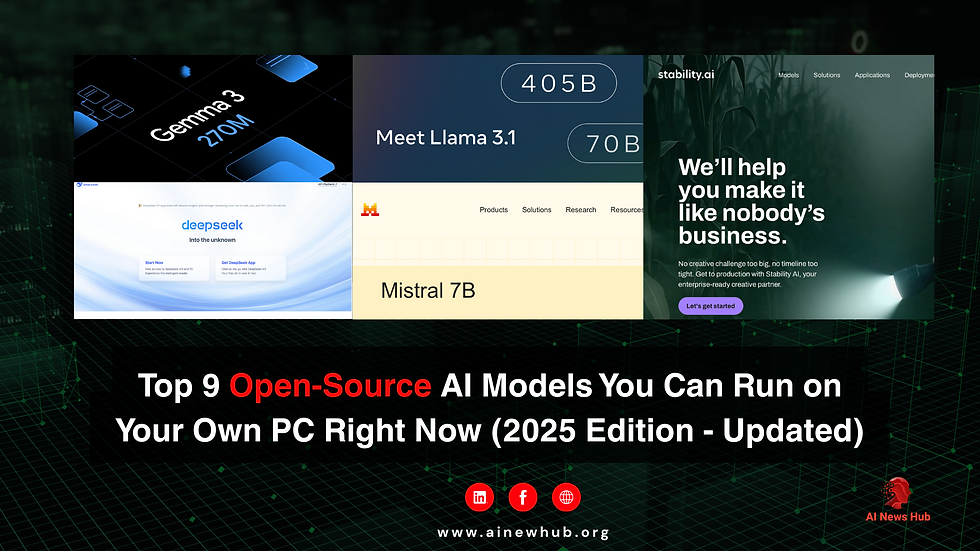
6. Open-Source AI Models Challenge Proprietary Giants

Summer 2025 witnessed a paradigm shift as open-source models began outperforming closed-source systems on key benchmarks, democratizing access to frontier AI capabilities.
Meta's Leadership
Meta's Llama 3.5 topped GPT-series models in Hugging Face evaluations for low-resource languages, proving that community-driven development could rival corporate R&D budgets. The model excelled in efficiency for code generation and multilingual translation at a fraction of proprietary costs.
Ecosystem Explosion
The open-source surge fostered innovation across startups building specialized applications. Tools for personalized education, healthcare diagnostics, and vertical AI solutions proliferated, empowered by developers worldwide who could fine-tune models without licensing fees.
The IP Controversy
Success brought scrutiny. Lawsuits over data scraping intensified, with publishers and rights holders challenging training data practices. Questions about model safety, alignment, and responsible release practices dominated open-source AI discussions.
Market Impact
For "open-source AI breakthroughs 2025," this represented a watershed moment proving that collaboration could match corporate resources. The movement forced proprietary providers to reconsider pricing and access strategies.
7. The TPU vs GPU War: Hardware Battle Intensifies
2025 saw the hardware wars reach fever pitch, with Google's Tensor Processing Units (TPUs) challenging NVIDIA's Graphics Processing Units (GPUs) in a high-stakes battle for AI training supremacy.

TPU v6 Launch
Google's TPU v6 release in March boasted 30% better energy efficiency and superior scalability for training massive models compared to NVIDIA's H200 GPUs. Independent benchmarks showed TPUs excelling in cost-per-FLOP metrics, making them attractive for sustainable AI training amid growing environmental concerns.
NVIDIA's Response
NVIDIA didn't concede ground easily. GPU optimizations for edge computing, the introduction of Blackwell B200 chips, and software ecosystem advantages kept NVIDIA competitive. The company's integration with frameworks like PyTorch and TensorFlow maintained developer loyalty.
Market Effects
Cloud providers AWS and Azure slashed prices to attract AI developers, democratizing access to high-performance computing. Industry analysts predicted this competition would drive down infrastructure costs by 20-30% through 2026, benefiting startups and researchers.
Broader Implications
The feud highlighted a broader industry trend: the shift toward specialized AI hardware. ASICs, custom silicon, and domain-specific accelerators emerged as viable alternatives to general-purpose GPUs, reshaping the semiconductor landscape.
8. AI-Powered Defense and Cybersecurity Revolution

One of the most critical yet underreported AI developments of 2025 was the rapid advancement of AI-powered defense and cybersecurity systems. As cyber threats grew more sophisticated, AI became the frontline defender for nations and enterprises worldwide.
Autonomous Threat Detection
Defense contractors and cybersecurity firms deployed AI systems capable of identifying and neutralizing threats in real-time. Companies like CrowdStrike and Palo Alto Networks integrated machine learning algorithms that detected zero-day vulnerabilities, ransomware attacks, and advanced persistent threats (APTs) with over 90% accuracy, reducing response times from hours to milliseconds.
Military Applications
NATO announced its AI Strategy 2025, focusing on autonomous defense systems for border surveillance, logistics optimization, and tactical decision support. The U.S. Department of Defense's Project Maven expanded significantly, using AI to analyze satellite imagery and predict potential threats with unprecedented accuracy.
Autonomous drones equipped with AI-powered target recognition systems saw expanded deployment, raising ongoing ethical debates about lethal autonomous weapons systems (LAWS). The discussions around AI warfare ethics intensified throughout the year.
Critical Infrastructure Protection
Power grids, water systems, and transportation networks adopted AI guardians to prevent cyberattacks. These systems used predictive analytics to identify vulnerabilities before exploitation, with documented cases of AI preventing major infrastructure attacks.
Market Growth
The cybersecurity AI market reached an estimated $30-35 billion in 2025, with projections to double by 2027. The AI arms race in cybersecurity intensified competition between nations, with China, Russia, and Western allies all accelerating defensive and offensive AI cyber capabilities.
9. Enterprise AI Agents Transform Business Operations
While consumer AI grabbed headlines, 2025 marked the year AI agents infiltrated enterprise operations at scale, fundamentally transforming business processes.

Autonomous Workflow Management
Companies deployed AI agents handling end-to-end processes: scheduling meetings, managing supply chains, processing invoices, and conducting preliminary sales outreach. Salesforce's Einstein GPT and Microsoft's Copilot evolved beyond simple automation to strategic business partners analyzing market trends and recommending pivots.
AI SDRs and Sales Automation
Startups like 11x.ai and Artisan launched AI Sales Development Representatives that generated qualified leads, personalized outreach at scale, and maintained CRM hygiene autonomously. Early adopters reported 40% increases in pipeline generation while reducing sales operations costs by 60%, though debates emerged about authenticity in AI-human business interactions.
Code Generation Revolution
GitHub Copilot Workspace, Cursor AI, and OpenAI's Codex transformed software development. AI agents wrote production-ready code, debugged complex systems, and deployed applications. Developer productivity metrics showed 35% faster feature delivery, though concerns about code quality and security vulnerabilities persisted.
Adoption Metrics
Estimates suggested enterprise AI agent adoption reached 60-70% among Fortune 500 companies by year-end, with organizations reporting average ROI of 200-300% within six months. Integration challenges and change management remained barriers for mid-market companies.
10. The Creator Economy Meets AI: Content at Scale
The intersection of AI and content creation reached a tipping point in 2025, fundamentally altering media, entertainment, and journalism.
AI in Journalism
News organizations deployed AI for automated aggregation, fact-checking, and preliminary reporting. Reuters and Associated Press expanded AI news writing programs, with algorithms generating significant portions of financial and sports coverage. Personalized news feeds reached new sophistication levels, curating content based on individual reading patterns.
Video Production Revolution
Tools like Runway Gen-3 and Pika 2.0 enabled creators to produce high-quality video content from text prompts. Independent filmmakers created short films using AI, while major studios integrated AI for special effects, reducing production timelines by 40-50%. Platform data suggested 10-15% of Q4 2025 content was AI-generated or AI-assisted.
Audio and Podcast Innovation
AI voice cloning reached near-perfect fidelity, enabling podcast creation in multiple languages while maintaining authentic voices. NotebookLM's audio overviews went viral, with millions using AI to transform documents into podcast-style discussions. Deepfake concerns prompted platforms to implement AI content labeling requirements.
The Authenticity Debate
As AI-generated content proliferated, audiences grappled with creativity and authenticity questions. Some creators thrived positioning themselves as "AI-augmented artists," while others faced backlash for over-reliance on automation. Copyright lawsuits from Getty Images and rights holders intensified.
Market Growth
The creator tools market reached an estimated $20-25 billion, with AI-native platforms disrupting traditional creative software. Adobe's Firefly integration across Creative Cloud and Canva's AI design tools democratized professional-grade content creation.
Additional Notable Developments
Quantum-AI Hybrids
IBM and Google made progress in quantum-AI integration, demonstrating applications in molecular simulations and optimization problems. While still early-stage, error-corrected qubits showed promise for drug discovery and materials science.
AI Ethics Regulations
Global regulatory frameworks evolved, with the EU AI Act implementation beginning and ongoing U.S. policy discussions. Organizations navigated increasing compliance requirements for high-risk AI applications.
Medical AI Advances
AlphaFold continued revolutionizing protein structure prediction, enabling drug discovery advances. AI-assisted diagnostics and treatment planning saw increased clinical adoption, though regulatory and ethical frameworks continued evolving.
Autonomous Vehicles Progress
Tesla's FSD (Full Self-Driving) system saw significant improvements, while Waymo expanded to 15 cities, completing tens of millions of autonomous miles. Regulatory fragmentation across jurisdictions remained a challenge for nationwide deployment.
xAI's Grok Evolution
xAI's Grok 4 enhanced real-time reasoning and X platform integration, increasing user engagement. The model became popular for dynamic queries and breaking news analysis.
Investment and M&A Activity
Funding Landscape
AI startups raised record amounts in 2025, with significant late-stage rounds. Notable raises included Anthropic's substantial funding (reaching ~$40 billion valuation), strong investment in AI infrastructure companies, and continued investor enthusiasm despite questions about profitability timelines.
Strategic Acquisitions
Tech giants made strategic moves: Microsoft's reported interest in cybersecurity AI companies, cloud providers strengthening AI capabilities through acquisitions, and continued consolidation in the AI tools and infrastructure space.
Market Valuations
OpenAI's valuation reportedly reached $150+ billion territory, while other AI leaders saw significant valuation increases. The AI infrastructure layer experienced explosive growth, with companies like Scale AI and Databricks achieving substantial valuations.
Investment Trends
VCs shifted focus from consumer generative AI apps to enterprise AI agents, vertical AI solutions, and AI infrastructure. The funding environment remained strong for AI companies while other sectors faced headwinds.
Looking Ahead: AI's Trajectory Into 2026
As 2025 closes, several trends point toward 2026's developments:
Expected Advances
Industry experts anticipate continued progress in agentic AI capabilities, potential AGI breakthroughs (though timelines remain uncertain), widespread AI agent adoption across industries, and evolution of multimodal AI systems.
Regulatory Evolution
Governments worldwide will continue developing AI frameworks, balancing innovation with safety and ethical considerations. Compliance requirements for high-risk AI applications will likely increase.
Workforce Transformation
As AI agents automate more knowledge work, reskilling and workforce adaptation become critical. Discussions around universal basic income, new economic models, and education reform will intensify.
Technical Challenges
The industry faces ongoing challenges: hallucination reduction, alignment and safety improvements, energy efficiency and sustainability, and bias mitigation.
Join the Conversation
Which 2025 AI moment had the biggest impact on your industry? Are you excited or concerned about AI's rapid advancement? Share your thoughts in the comments below.
Stay Ahead of AI Innovation
Subscribe to AI News Hub's newsletter for weekly AI insights, breaking news analysis, and exclusive coverage from major tech events including GITEX Global, GISEC, and AI Summit Seoul.
Follow us for comprehensive coverage of AI developments that matter to your business and career. Whether you're a tech leader, developer, investor, or AI enthusiast, we deliver the intelligence you need to navigate the AI revolution.


Comments